Showing posts with label Cards for Math. Show all posts

Thursday, April 2, 2015

7 Sevens


7 Sevens is a fun game the whole family can play. 

Children get practice with addition facts to 6+6 and recognizing numerals. They also learn to take turns and keep good attitudes while playing.

Grandsons Jacob, 8, and Aaron, almost 6, came for a visit and since we rarely have time with just us, we played some games. 


7 Sevens is a favorite game of all the children. We play it in many different fashions. Today we used number cards and counters. Each player gets a set of cards numbered 2-12 and 7 counters. 
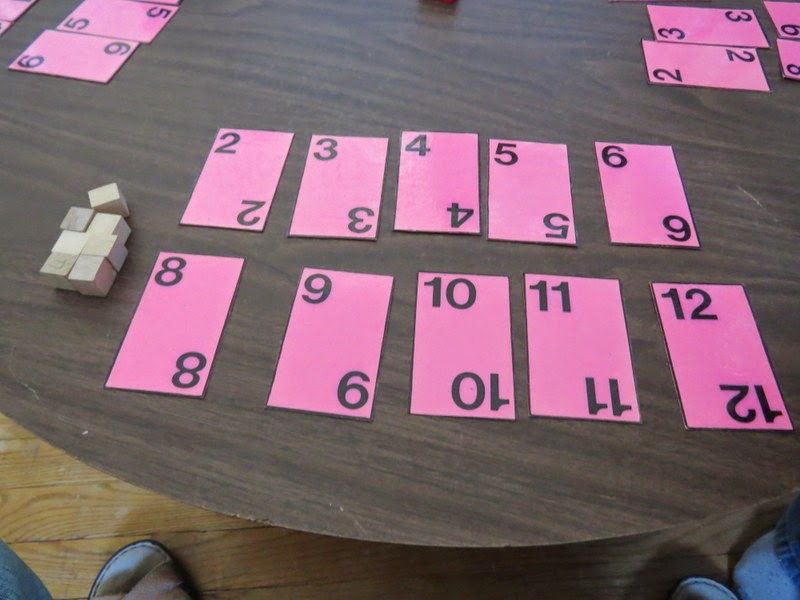

The cards are placed in front of each player so they are visible to all. The counters are set to one side.


Two die are needed. I prefer to use numbered die rather than the ones that have the dots. The dots can be good for beginning players so they can use the dots as a visual for adding. However, these boys know or almost know the addition facts and just need more practice. Here a player rolled 2+2 which equals 4.


Since he rolled a four, he turns over his four card and the play moves to the next player.

The next roll...

...is 7 and this is the FUN part. Rolling a 7 costs the player one of his counters. 

Play continues with each player taking turns rolling the dice and turning over the appropriate card or losing one of his counters. If a player has already turned the needed card over, he simply passes the dice to the next player.


When a player rolls a 7 and has to give up his last counter he is out of the game.

Poor Jacob. 
 But the game continues for Aaron and I....

Who WINS? The first player to successfully turn over all his cards. This can be difficult because some of the numbers are harder to get. OR the winner is the last player in the game when other players have lost all their counters.

However...Grandma always wins in that I get to have a fun time with the children. Also they get some addition practice and they don't even realize they are "doing school." ....but don't tell them. 

Tuesday, September 10, 2013

Go Fish Roman Numerals

Now we used the cards with the cute little fish on them for the game they were intended...GO FISH!

 Here is Diana's hand. She had asked Douglas for a 3 and received one. So she had her first match.

 Wesley is asking for a card. We played that if you were holding the Roman Numeral card you could simple state the number you needed to make the match. However, if you were holding the number and wanted a Roman Numeral you had to state how it would appear using I, V and X's. For example, Wesley requested XII since he had the 12 card in his hand.

Of course, the fun comes if the person does not have the card you request and says, "Go Fish!" Then you get to draw from the pond of cards in the center of play.
Douglas played with Wesley and Diana. We had a fun time.

Roman Numeral Search

We call it SEARCH, but this game is known by other names, as well....Concentration and Memory.

 We began with only 10 cards - the 1 - 5 and their Roman Numeral matches.

 Ladies first...so Diana started and selected two cards which were not a match.

 Wesley went next and made a match with the 5.

 Later Diana made her first match.

Then we tried the game with all 24 cards (1-12 and the matching Roman Numerals).
 We put the numbers to one side and the Roman Numerals to the other in an attempt to make it a little easier for Diana.
 You can see she is a little overwhelmed with the number of cards.

So...Douglas stepped in and took her place.

 Douglas matches the 8.
Wesley matches the 3.

It was a much better game and the boys both enjoyed it. Wesley got more practice.

Roman Numeral Match

We introduced Diana,4, to Roman Numerals today. She caught on fairly quickly. Wesley needed the quick review and he remembered them all.

The Cards

The cards were made to be played for a Go Fish game, which is why the cute little fish is on each card. The deck consists of 24 cards: 1 - 12 in both Roman and Arabic numerals.

 First we set out the 1-12 cards. The Roman Numeral cards were shuffled and up in a stack. Diana drew cards and handed them to Wesley to place above the correct number.


 Wesley would state the number as he placed the Roman Numeral cards. He would also explain each card/number to Diana. This gave him good review and continued Diana's introduction to Roman Numerals.


 Activity finished...

Now Diana gets a turn.
 Wesley handed her one card at a time and she place the number below the correct Roman Numeral. This was quite easy, but it gave her some confidence.

Next we did the first activity again with both children taking turns.
 Diana was excited to get one she knew.
...and she knew right where to put it.

We had fun. Wesley got some good review and Diana got her first introduction to Roman Numerals.

Monday, September 9, 2013

Doubles Addition Cupcakes

"Cupcakes" is in the name simply because of the fun cards we used. The children enjoyed drilling simple addition doubles facts.


The Cards

Made from bulletin board strips...
 The strips had cupcakes in several colors. I cut them apart and have saved them for quick use for games. Today I used the purple ones I had left. On the back I wrote the addition facts for the doubles from 0 + 0 =  to 14 + 14 =.  I did them both in vertical and horizontal form. I did to 14 simply because that was the number of cards that I had.

Introducing the Cards

First we did a little activity. I set out the 0 + 0 =  cards. I showed them two empty spots. I asked how many counters we would have if we combined/added the two empty spots. ZERO, of course, was the answer. Next they each put 1 counter in each space. I asked how many we would have if we added 1 + 1 and they shouted TWO.  We continued adding one counter to each pile and stating the new addition fact. Wesley, age 6, knows many of them, but soon realized that the answers were counting by TWO and so he predicted what the next answer would be. This was a great discovery for him to make and one I had not planned.

We finished going through all the cards (facts to 14 + 14 =) just so Wesley could see that his predictions continue. Then we got down to drilling some of the facts. We used only the first six facts (up to 5 + 5 =) to now play some games. Even though the first things we did were not REAL games, by calling the such, the children excitedly played. (They thought of it as play, because, after all, I was calling it a game.)

First I gave them each a set. Wesley had the horizontal form and Diana, 4, had the vertical. They laid them out in front of themselves and we drilled the facts in any way I could think of.

1. I placed them in order and drilled them each through their cards. They would read the fact and give the answer.

2. Next, I skipped around, pointing to cards out of order. They again read the facts and gave the answer.

3. I mixed up their cards and they stated only the answers to each fact.

 Here Diana is giving the answers to her fact cards. While Wesley finds his matching card.

Next we played some REAL GAMES.

Game 1 Since Diana is two years younger I started with One At a Time Take. For this game I shuffled all the cards. I held up one card at a time and they took turns giving the answer. If they answered correctly, they got to collect the cupcake. (Calling them "cupcakes" instead of cards, just makes it more fun.) If they gave an incorrect response, the other person got to give an answer and collect the card. We did this several times until they were both doing it pretty rapidly.

Game 2 I called this Speed Cupcake Take. This time when I held up the card both Wesley and Diana tried to be the first to give the answer. Wesley won the first two cards and Diana was getting discouraged, but I reminder her that she knew these now and if they tied, she would win the card. She sat back up and won the next card, mostly because Wesley wasn't paying attention...but she was so excited. She tied him a couple times and ended up with 5 of the 12 cards. However, before Wesley could count them and declare he had beat her, I swept up the cards and shuffled them and said, "Let's go again." The second game she got 7 of the cards, but again I tried not to make a big deal about a "winner." Because, if you have a winner, there must be a loser...and no one wants to be the loser.

We had fun with this quickly made game and the children are memorizing these facts. Tomorrow we will do them again and probably add one or two more fact cards.

Games make drilling so much fun. Flash cards could be used, but making the "pretty" cupcake cards and calling it a GAME, made it much more fun.


Friday, February 15, 2013

Roman Numeral Oh Nuts!

Usually we play Oh Nuts! with a gameboard. You can see one and how we use a board here:
However, we just played it as a card game and it was a hit with the boys. They have enjoyed our time with Roman Numerals. I introduced Roman Numerals to Charles with Fun with Roman Numerals by David Adler. It caught his attention right away because the illustrations show Roman soldiers. We also made some Roman Numeral coins which I will blog about in another post.

To Make: Two sets of cards are needed. On the first set (cut 2x2) I stamped I, V, X, L, C, D and M....about 12 or so of each. I had a perfect stamp set, but they could easily be hand written or printed on the computer for those of you that can do that. You also need a little bar card if you are going to do numbers like 5,000 or 10,000 which we did.
First set of cards - Roman Numeral Cards
NOTE: I did each of the Roman Numerals on a different color of card stock so they would be easy to sort.

Second set of cards - The number cards
The second set (2X3) has numbers on it (a wide variety of numbers...depending on how high you are working with Roman Numerals). These cards I just hand wrote. I could have used another stamp set, but didn't even think of it at the time...LOL. I also wrote the Roman Numeral answer in small letters at the bottom of the card. Also...and this is what makes the game fun...about 1/3 of the cards need no number, but the words OH NUTS! written on them.

Cards set up for play when two children play alone.

To Play: I was the dealer. The kids could play alone, but they always enjoy it more if I am involved. When the children play alone, one child must draw the card for the other players since the answers are on the front of the cards.

Douglas draws and reads a card for Charles.

Charles went first. (NOTE we changed the rules some as we went along. Never be afraid to adjust things to make the play more fun.) I had shuffled the number cards and the Roman Numeral cards were in separate piles on the floor in front of the boys.
Douglas and Charles
The player has 2 choices as he starts his turn. He may take the top number card or PASS and take the next card. If the card has a number on it he uses the Roman Numeral cards to make the number. If correct, he collects the number card to his temporary pile. Now he can go again IF he wishes to. He takes the next card (or says PASS and then he must take the second card). He then again, makes the number... 
Douglas draws an Oh Nuts! card for Charles
...UNLESS it is an OH NUTS! card. If at anytime he chooses an Oh Nuts! card, he must forfeit all cards in his temporary save pile.
Poor Charles!
However, at any time after collecting a card, a player may choose to end his turn and move all cards in his temporary save pile to a permanent save pile (these cards cannot be lost). Then the turn passes to the next player.
The player with the most cards in his permanent save pile is the winner. Because of the luck of the game, Charles, 7, who is just learning Roman Numerals, was the winner over Douglas, 9, who knows them quite well.
NOTE: Because Charles is just learning we often helped him a little as he was making his Roman Numerals. Normally, a wrong answer would also cause a player to forfeit any cards in his temporary pile and end his turn, but we choose not to use this rule....at least not yet.

Check out the Roman Numeral Coins we made.

Tuesday, February 7, 2012

Numerical Order - A Card Game

Deal out 3 - 10 cards to each player. 

Say "Go!"

Players place their cards in a row face-up on the table. 

Then players rearrange their cards, in order from lowest to highest (left to right). 

Because we are playing with limited numbers here, players may get duplicates or more of one number. Same numbers are placed on top of each other.

When a player has his cards in order, he shouts, "In Order!" and all players must stop. His cards are checked. If he has them correctly arranged, he scores 10 points for the round. If incorrect, he scores zero and all other players count their points.

Other player points are scored by starting at the left and giving one point for each card that is in correct order. When a misplaced card is reached, scoring ends. For example: If the player had out the numbers 1, 5, 7, 6, 9, 14, 15, 18, he would score 3 points for the first three cards are in correct order. Even though most of the rest of the cards are in correct order, scoring would end at the 6 which is incorrectly placed.

Play for 10 rounds (or any other agreed upon number of rounds) keeping a total of points scored.

VARIATIONS

1.  Deal 3 cards the first round, 4 the second, 5 the third and continue to 10 (or even 15) cards.

2. Use fractions, mixed numbers, decimals instead of whole numbers.

3. Have math facts on the cards. Arrange the cards by their correct answer.

4. Use much larger numbers, such as thousands, ten thousand, hundred thousands, or even millions.

5. Play with a scoring variation. If playing with fractions, give fractional points. (If there are six cards in play and a player completes the order, he would score one point. If he had 3 cards in order, he would score 3/6 or reduce it to 1/2. This would give the players some good practice in addition of fractions, especially if a different number of cards is dealt each time, thus giving different denominators.)  Get creative with the scoring for great math practice!

Thursday, December 29, 2011

SPEED! Variation 2 - includes finding averages

Another version of SPEED! that the boys can play on their own is what we call SPEED! Cross-Out.

For this game the player has to write the sequence of numbers he is working on. Here Douglas is working with the SEVEN SPEED! cards.  So he writes the numbers 7, 14, 21, 28, 35, 42, 49, 56, 63, 70 three times in columns on a sheet of paper. 


Then he shuffles the cards and flips one over at a time. Working with only one column at a time he crosses off the number turned. If the number has already been crossed off, he simply flips another card.


When a player has crossed off all the numbers, he counts how many cards he flipped and that is his score for that round.

 Douglas

Charles

After he has completed three rounds, he figures his average and that is his score for the game.

In this way, Douglas, age 8 and working on the SEVENS, and Charles, age 6 and working on the THREES, can compete. Douglas gets the extra practice of the skill of figuring averages.

SPEED! Variation 1 - Solitaire Play

Because I am working with 4 - 6 children each day, I find it necessary to find ways for the children to do work independently. SPEED! works well for some fun drill that they can do on their own.

Following the basic rules of play, the children can play by themselves.

 Douglas shuffles the deck.

 He keeps all the cards for himself. He places four cards face up to be his playing cards and two cards to the center to be the cards he plays on.

 Then following the rules of the game he places cards from his playing cards to the center. He places cards that are one higher or lower in the skip-counting/multiplication table he is playing with. Here he is using the SEVEN SPEED! cards. 

He replaces any of the four playing cards used with new cards from the deck he is holding. If at anytime, NO card will play on either pile, he takes one card from his deck and places it on one of the center decks. 

The object of the game played this way is to have as few cards as possible remaining in his playing spaces, having played them all to the center.  Having zero cards remaining would be awesome. However, if they have 1 or more left, it is easy to encourage them to play again to see if they can have fewer the next time....so MORE DRILL...we all win!

 Here Charles is playing with the THREE SPEED! deck.

 See his joy at getting ALL the cards to the center. A perfect game!

He enjoys the success!