Showing posts with label Addition. Show all posts

Tuesday, July 14, 2015

Wilbur - A Favorite Learning Tool


Remember Wilbur of "Charlotte's Web" fame? 
Wilbur is a most versatile format and a favorite of young children.
Turn an old bleach bottle into a "funtastic" learning tool! 


Draw eyes and a mouth with permanent markers.
Add pink felt ears and a pipe cleaner tail.
Use egg carton sections for feet.
Decorate sides as desired.
Cut a slit about 1/4 inch wide across his head, just behind his ears.


These were the old instructions for making Wilbur and I have made many this way. But, like everything else, he got an update.  


This is the original very first Wilbur after his many face-lifts. This guy is around 30 years old. Looks pretty good for his age I think. The permanent marker needs a new paint job every few years to keep it bright. The tail has been replaced a few times and the ears have had to be reattached. 

The biggest improvement is his feet. There has been much trial and error with these. Egg cartons just glued like in the first picture was the start. Different glues were tried. Later, stones were added to give extra weight and help with balance. The stones are important, be sure to add some to each egg carton section. Finally,one day I just grabbed the good old duct tape and covered it all. Finally, a good solid base that has held up for a couple years. The next improvement will be to look for a color different than the yellow and make it more to my liking. But the key is that he now works, is stable, and has held up for some time. 

Here is Wilbur in action:  

With a stack of skill cards placed in the slot, Wilbur is ready to teach. For these cards, Charlotte counted the items and stated the number.

To view the answer, the child removes the bottle cap and peers inside.

Charlotte removed the cap and looked inside to see the answer revealed. If she is correct, she simply takes the card out and another is already in place. NOTE: Children enjoy removing the cap, so I suggest they put it back on before they change the card.

Here is what she saw when she looked inside. 


The cards should measure about 5 inches by 8 inches. 

Put the "skill" at the top edge of the card. 

The correct answer should be at the bottom center of the card.


Here are a few examples of the many possible skills that can be put on cards. 

Douglas was beginning to read and we made these card for him to recognize his name and the names of those most important to him.

Beginning letter sounds

Beginning blends and diagraphs

Fill in the missing vowel

Read the number words

Addition

Multiplication

States and Capitals - notice this set was written by one of the children. Having them make the cards is just another step for them to be learning the skill.

Questions to review a unit on bees.

Wilbur is enjoyed by ALL ages and I guarantee when you put him out with some cards, EVERYONE will have to remove the cap and take a look.

Hope Wilbur is loved at your house as much as he is at ours. 


Thursday, April 2, 2015

7 Sevens


7 Sevens is a fun game the whole family can play. 

Children get practice with addition facts to 6+6 and recognizing numerals. They also learn to take turns and keep good attitudes while playing.

Grandsons Jacob, 8, and Aaron, almost 6, came for a visit and since we rarely have time with just us, we played some games. 


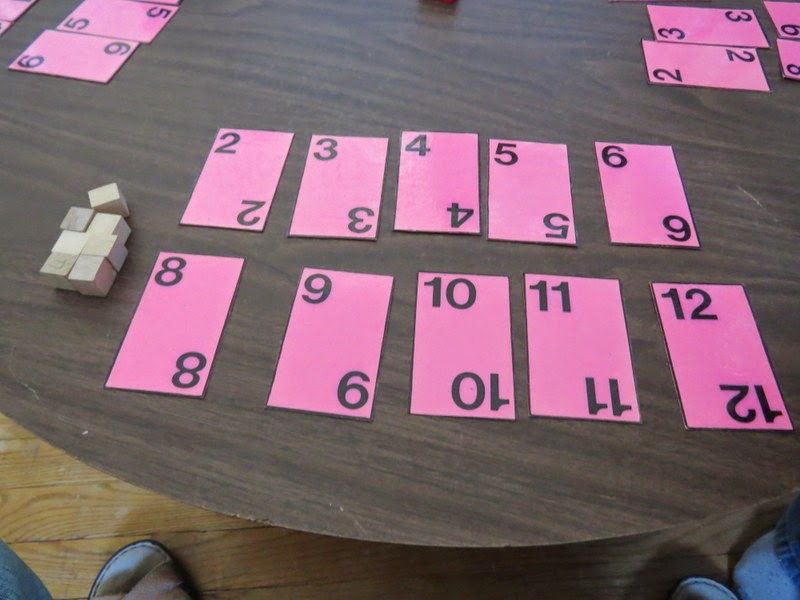
7 Sevens is a favorite game of all the children. We play it in many different fashions. Today we used number cards and counters. Each player gets a set of cards numbered 2-12 and 7 counters. 


The cards are placed in front of each player so they are visible to all. The counters are set to one side.


Two die are needed. I prefer to use numbered die rather than the ones that have the dots. The dots can be good for beginning players so they can use the dots as a visual for adding. However, these boys know or almost know the addition facts and just need more practice. Here a player rolled 2+2 which equals 4.


Since he rolled a four, he turns over his four card and the play moves to the next player.

The next roll...

...is 7 and this is the FUN part. Rolling a 7 costs the player one of his counters. 

Play continues with each player taking turns rolling the dice and turning over the appropriate card or losing one of his counters. If a player has already turned the needed card over, he simply passes the dice to the next player.


When a player rolls a 7 and has to give up his last counter he is out of the game.

Poor Jacob. 
 But the game continues for Aaron and I....

Who WINS? The first player to successfully turn over all his cards. This can be difficult because some of the numbers are harder to get. OR the winner is the last player in the game when other players have lost all their counters.

However...Grandma always wins in that I get to have a fun time with the children. Also they get some addition practice and they don't even realize they are "doing school." ....but don't tell them. 

Monday, September 9, 2013

Doubles Addition Cupcakes

"Cupcakes" is in the name simply because of the fun cards we used. The children enjoyed drilling simple addition doubles facts.


The Cards

Made from bulletin board strips...
 The strips had cupcakes in several colors. I cut them apart and have saved them for quick use for games. Today I used the purple ones I had left. On the back I wrote the addition facts for the doubles from 0 + 0 =  to 14 + 14 =.  I did them both in vertical and horizontal form. I did to 14 simply because that was the number of cards that I had.

Introducing the Cards

First we did a little activity. I set out the 0 + 0 =  cards. I showed them two empty spots. I asked how many counters we would have if we combined/added the two empty spots. ZERO, of course, was the answer. Next they each put 1 counter in each space. I asked how many we would have if we added 1 + 1 and they shouted TWO.  We continued adding one counter to each pile and stating the new addition fact. Wesley, age 6, knows many of them, but soon realized that the answers were counting by TWO and so he predicted what the next answer would be. This was a great discovery for him to make and one I had not planned.

We finished going through all the cards (facts to 14 + 14 =) just so Wesley could see that his predictions continue. Then we got down to drilling some of the facts. We used only the first six facts (up to 5 + 5 =) to now play some games. Even though the first things we did were not REAL games, by calling the such, the children excitedly played. (They thought of it as play, because, after all, I was calling it a game.)

First I gave them each a set. Wesley had the horizontal form and Diana, 4, had the vertical. They laid them out in front of themselves and we drilled the facts in any way I could think of.

1. I placed them in order and drilled them each through their cards. They would read the fact and give the answer.

2. Next, I skipped around, pointing to cards out of order. They again read the facts and gave the answer.

3. I mixed up their cards and they stated only the answers to each fact.

 Here Diana is giving the answers to her fact cards. While Wesley finds his matching card.

Next we played some REAL GAMES.

Game 1 Since Diana is two years younger I started with One At a Time Take. For this game I shuffled all the cards. I held up one card at a time and they took turns giving the answer. If they answered correctly, they got to collect the cupcake. (Calling them "cupcakes" instead of cards, just makes it more fun.) If they gave an incorrect response, the other person got to give an answer and collect the card. We did this several times until they were both doing it pretty rapidly.

Game 2 I called this Speed Cupcake Take. This time when I held up the card both Wesley and Diana tried to be the first to give the answer. Wesley won the first two cards and Diana was getting discouraged, but I reminder her that she knew these now and if they tied, she would win the card. She sat back up and won the next card, mostly because Wesley wasn't paying attention...but she was so excited. She tied him a couple times and ended up with 5 of the 12 cards. However, before Wesley could count them and declare he had beat her, I swept up the cards and shuffled them and said, "Let's go again." The second game she got 7 of the cards, but again I tried not to make a big deal about a "winner." Because, if you have a winner, there must be a loser...and no one wants to be the loser.

We had fun with this quickly made game and the children are memorizing these facts. Tomorrow we will do them again and probably add one or two more fact cards.

Games make drilling so much fun. Flash cards could be used, but making the "pretty" cupcake cards and calling it a GAME, made it much more fun.


Thursday, June 27, 2013

The Alligator Game - Greater or Less Than

To compare decimals, fractions & percent

However...it would be great for any skill that requires comparing of numbers...


I used a blue file folder, added a picture of an alligator, and white circle stickers as a path. On the path spaces I wrote the signs for greater than, less than, and equals.

WHY AN ALLIGATOR? Our math book should a cute little bird with its open mouth. The greater than or less than sign was the birds mouth.

The open end of the greater than or less than sign is always towards the larger number. However, the year I made this I had a large percent of boys in my class and when I mentioned an alligator's open mouth, I got their attention...LOL...so the alligator on our gameboard!

To play, a player will draw a card, decide the relationship of the first number to the second and move to the next space with the appropriate symbol.

The cards have things like: .4 ___ .04, .71 _____.8, etc...for
decimal practice.

Another set of cards I made had: 3/4 ____ 3/12, 4/6
___2/3, etc. for fractions.

This board could be used for so many other math skills as well. For example:

1 week ______ 8 days

17 ounces _____ 1 pound

3.75 ____ 3 3/4

1.5 ____ 150%


IV ______ X

5 + 4 ______ 3 + 6

59 - 17 _____ 47 - 5

Or even for other classes:

Population of Texas _____Population of Wisconsin

Length of robin ______ length of gold finch

Revolutionary War ______ Civil War (The children had the open end to the later date.) This is a great way to help them get events in order without having to necessarily remember exact dates. So they would read their card as "Revolutionary War was earlier or before (rather than later than or after) the Civil War.


ANSWER KEY: To make it so children could play without a parent/teacher, provide an answer key. However, I preferred to just write the correct answer on the reverse of the question card. The question cards were in the pile, face up. After a child gave the response, the card could be turned over to verify the answer. This saves from lost answer keys, and is a much easier way of checking. 


There is a cute little song on YouTube that can be used when introducing Greater Than/Less Than. Check out the Number Eating Alligator Song.

Wednesday, March 20, 2013

Find the Answer - Addition & Subtraction Facts

"Find the Answer" is one of the children's favorite games to play. It is easy to make, fast to play, and fun for all ages.


To Make:

Make a collection of ANSWER CARDS that children will be required to find. These can be made using index cards, slips of paper, or any other supply you may have on hand. On each write the answer to a question you wish to drill, review, or test the child(ren) on. The child will read each answer card as (s)he hides it around the room - trying to remember where he placed each card.

QUESTION CARDS can be made using the same type of supplies as above, or the parent/teacher may verbally state a question.

You will want to keep the number of card pairs small for young children. Older children can handle more pairs. I still limit the number of pairs we play with at one time to about 10 even with the older boys.

Here Diana is reading one of her QUESTION CARDS. We are drilling math facts.

She takes a closer look. That might help.


After hunting around the room, she shows the correct ANSWER CARD she found.
The child will go around looking at each card they hid attempting to find the ANSWER CARD that they need. 
Diana shows the QUESTION and ANSWER CARDS together.

Wesley shares the cards that he has put together.
 Diana and Wesley played at the same time. I gave them each cards to hide and I had a set of QUESTION CARDS for each of them.

Wesley found the 6 he needed hidden in the bottom of the Charlotte's activity seat.
 Diana searched and searched for one of the ANSWER CARDS but could not find it. When the children are hiding their ANSWER CARDS it can be a big help for me to watch where they are hiding them so I can give suggestions of places to look. This can be important. Some time ago we were playing Find the Answer - States & Capitals. One ANSWER CARD could not be found while we played. Several days later, one of the children found it hidden between a couple books on a shelf.

Diana asks for help finding a card she needs.


The children bring their ANSWER CARDS up and match them to a Question Card

Think of all the possibilities for this game! We have used it for phonics, math, states & capitals, clocks & time, and words to read... so far.


Addition & Subtraction Equations - Education Cubes

Diana has recently been introduced to subtraction on paper. So the minus sign is rather new to her. I noticed that she was treating all problems as though they were addition. So I made an education cube with 3 plus signs and 3 minus signs.  The children took turn tossing the cube and shouting out PLUS or MINUS.


After a few minutes of this we changed to ADD or SUBTRACT. When I let them shout, they think it is a GREAT game! This rule depends on whether or not the baby is napping OR the noise level I can tolerate at the moment.


Then we added two number cubes. I kept the numbers low for Diana's benefit for now. (We have used larger numbers with Wesley, and much larger numbers with the older boys.)


Diana and Wesley took turns tossing the three cubes, lining them up and giving the correct solution to the equation.


Diana would get very excited when it was an equation she KNEW the answer to. For other, harder ones, she would do some counting to get the solution. By the time we finished playing she had memorized several more facts.


At times, Wesley offered some assistance.....


Be sure to check out some of the other games we play with these education cubes.

Thursday, December 29, 2011

Math War Cards - Game 1

I found some math cards at Goodwill. They were in like new condition and selling for only 49 cents. So I purchased them. I knew the boys would love playing with the colorful cards which have addition and subtraction facts.

For the first game, we played the way the directions intended. Wesley and Charles played. Wesley, 4, is just learning his addition and subtraction facts, so he needed a slow paced game which would allow him all the time he needed to figure out the answers. He even kept a package of counters handy in case he needed some help. Charles, 6, knows most of the facts fairly quickly, so he would not be an even match for Wesley.


The cards were shuffled and then dealt out evenly between the two players (more players could play). The players place their decks on the table in front of them. Each turns over their top card and states the addition or subtraction problem and then states the answer. The player with the largest answer collects both cards. In case of a tie, each player places out another card, giving the new answer. The player that has the largest new answer wins all four cards.


Wesley has to think for a minute to find the solution to his math card.  Sometimes he used counters to help him for the answer.

  Charles.

Tuesday, November 15, 2011

Team Work - Working together to win!

The boys here are so competitive and hate to lose. So I had them working together. Here is what we did:

We used our deck of cards 1-12 (four of each). I appointed Charles, 6, the super hero in red, to be
the captain for the game. 


We were drilling addition. I shuffled the deck and then turned over two cards at a time. Charles would choose who would add the two numbers together. The only condition was that each child had to be the one giving the answer before a child got another turn.

If a 1 or 2 was one of the numbers, Charles appointed Wesley, 4, to be the one to give the response. If it was harder but Charles knew the answer right away, he would give the response. He counted on Douglas, 8, to give the answer for the team when he did not immediately know the answer.

This was the fun comraderie they showed all through the game!

Wesley, 4, was so excited that he was able to play along with the older brothers and be a real part of the team.