Thursday, January 14, 2016

Generic Board Games - Part 2

Here are some more generic gameboards. See original post on Generic Board Games for explanation on what these are and more on how to use them.


Ocean Treasure

Ocean Treasure
 This easy-to-make gameboard used pictures cut from a children's book. Yes, I do cut books. Check out my blog on that topic. 


Who Wants to be a Millionaire

Who Wants to be a Millionaire

Any skill cards can be used here. Age levels can easily be mixed as each child gets questions from his own selected skill cards. Children may even be reviewing/drilling very different subjects. Check out here how to make and play this fun game.

Oregon Trail

Oregon Trail

This quick and easy-to-make gameboard was created to review a book on ....you guessed it - The Oregon Trail. 

The cute wagon is from bulletin board border strip. The path path is Avery 3/4" brown circle stickers. The special spaces along the path a filefolder label stickers.

I don't know if you are able to read the special spaces, so here are what we chose to put on them. In order that they appear along the path:

Big River - need even number to cross.
Sight Buffalo - lose one turn to hunt.
Indian Attack - lose one turn.
and finally: Oregon Territory.

Animal Mania

Animal Mania

The pictures were again cut from a book. This book was a favorite for cutting animals. It was an old Golden workbook, the kind we would find near grocery check-outs. I still on rare occasions find this at garage sales--often in FREE boxes as all the pages have been done. But the pictures are so nice for games and other projects the children enjoy. 

Notice that the stickers that were once white have changed over all these years, but the game is still a good one. Children always love animal related games, even if we are drilling "boring" multiplication tables. 

Wednesday, January 13, 2016

Who Wants to be a Millionaire?

Not having a television except for video watching, I had not seen this show until it had become a popular hit. Visiting my son, I saw it for the first time with his family. His kids were excited about watching it, though they are young and most of the questions were way beyond their education. But what interested me the most was that they still watched the whole show cheering on the contestant and shouting advice about answers and how to use his "lifelines."

As I thought about this show more in the days to come and thought about its appeal to these children, I figured there had to be a way to make this game and use it for their education.


TO MAKE:
I wanted something a little different than a traditional board game. I decided to use library pockets (You know those card holders in the back of library books, before many libraries went completely to using computers to track books.) I cut these in half, and taped them to make two pockets out of each one, as I needed smaller pockets. I wrapped the pocket portion in clear Contact paper to make it more durable.

Then I glued these in three rows (five in each row) on a pretty blue file folder. I used some file folder labels that were trimmed in blue below each one to indicate the level of question. I used the same levels as they do on the show: $100; $200; $300; $500; $1,000; $2,000; $4,000; $8,000; $16,000; $32,000; $64,000; $125,000; $250,000; $500,000; and $1,000,000. I put a gold sticker on the $1,000 and $32,000 pockets to indicate these as safe levels (Once reached this progress can not be lost.)

Now for the part that became the biggest hit with the kids: I used flat wooden spoons (The kind you can get at stores when you buy a malt cup or single serving of ice cream.) to make their playing pieces. These fit nicely into the pockets. To personalize each, I cut a snapshot of the child and glued his picture to the stick. I made some extra "players" in case a friend comes and wishes to play. He could chose from the Big Bird or Winnie the Pooh game pieces.

I made some special "lifeline" cards:
50/50 - The question will be rephrased as a True/False question or a choice of two answers will be given.

HELP - The player may ask anyone available for help...this can include calling Grandma on the phone.

BOOK - The player may get any book in the house and look up information.

NEW QUESTION - The player may choose to receive a completely new question.

HINT - The player will be given an age appropriate clue.

At the beginning of the game, these "lifeline" cards will be shuffled and three dealt to each player OR players may select three of their choice....some players like different ones than others.

For the game that I gave to my son's family, I included two sets of question cards I had from a trivia game that I bought at a used curriculum sale. I gave them the set for first graders and second graders as these were the right ages for the boys. However, I later made them some cards fitting more with things they are actually working on.....but they were so excited and wanted the game NOW.

TO PLAY:

Play is similar to the game show. However, we wanted all players to be able to play at the same time, not just one "contestant" (though this is a great game for the "only" child).

All players place their game piece in the first pocket. In turn each is asked a question and if successful, they move their game piece to the next level pocket. They may use their "lifeline" cards any time they choose for assistance with a question.

Any time a player wishes, he may quit and keep the money he has won. I made some fun money and pay the children. They can keep this money forever.....I just print some more. If a child, misses a question, he must return to the last "safe" pocket and collect that amount of money. He may, however, remain in the game...he simply must start at the beginning again.

When I was playing with the grandchildren the first time, and Kris made a mistake, he was heartbroken, but the pain seemed less as he received some fun money and realized that he was not out of the game...that he could start fresh again, with new "lifeline" cards. As it turned out, Kris was forced to start over more often than his older brother Kyle, however, Kris ended up with more money when we quit playing for the day. They left their game pieces right in the pockets so they could start up in the same places the next time we played....which turned out being within an hour as they were excited to get back to winning more money.

This game is fun for the whole family. Each member can be playing at his own level as the questions can come from cards made/selected especially for each one. Mom and Dad can participate too...get the questions from an adult trivia game for them to use.

Cutting Books to Make Games

Yes, you heard me right!

I do cut pictures from books. 

Many of the books are children's workbooks. They often have the best pictures. Especially if you are looking for pictures for a phonics game, grab a phonics workbook. I save pages from the children's workbooks when they have good pictures on them. I have taught the children to be careful of writing on the pictures. Even when I taught in the classroom, the students were careful to not mess up the pictures. They knew that I would use some of the pages to make games for them to play.

I love when I find some of my favorite workbooks at garage sales and often in the FREE box. People feel because the pages have been done, the books are worthless. Even if I only can use a few of the pictures, I am sure to grab it.

I will also buy books, knowing I am going to put them straight into my cutting box. These, of course, I hope to get for 25 cents. 

Tuesday, January 12, 2016

Generic Board Games 101

What is a Generic Game Board?

The simple answer is it is a game playing board that has no educational skill directly a part of the board.

As example, if you are working to teach your child colors and needed a simple game, you would probably choose Candyland. The colors are on the skill cards and also a part of the playing board.

However, if your child no longer needs this basic skill, Candyland can become a generic gameboard. New skill cards would need to be provided. Maybe the child would draw a card with a letter on it and be required to give the sound it makes, a word that begins with that letter, or the name of the letter. After giving a correct response, the child would draw one of the Candyland cards and that would indicate how far he could move. The skill is no longer a part of the board.

This leaves the possibility that the format (method of play) is still Candyland by its rules, but so many skills could be used to play the game.

Simply grab ANY game skill cards you may have or even flashcards and use the Candyland board and rules and have some fun drilling the skill.

Examples of Generic Gameboards

Save the Princess
Save the Princess

Using a blue filefolder I attached the two pictures. These are notepads I had on hand and seemed a natural for my daughter who was princess crazy at the time. The spaces are 3/4" circle stickers that can be purchased at most big box stores or office supply shops. After attaching the pictures, adding the name to the knight's shield, and creating the path, I covered both halves of the filefolder with clear Contact paper. Next I attached some fun gems I had in my crafting supplies. I notice that a few of the gems have disappeared over the years, but the board is still usable for my granddaughters. 

To Play: Players select a game piece and place it on the knight. In turn, players give a response to a skill card. When they have given a correct answer (even if help is needed), they shake a die and move the indicated number of spaces.
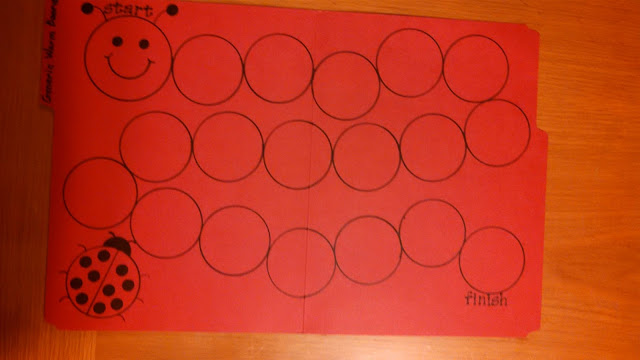
Generic Worm Board
Generic Worm Board

Using a red filefolder, I drew the path using a circle template. I added the simplistic art work and wording. No need to cover this gameboard as there is nothing special to protect. If the gameboard wears out it is easy enough to remake.

To Play: This is a great board for younger players as the spaces are large. It is also a fun time to use some of our larger game pieces. After placing their chosen pieces on start, players would take turns responding to whatever skill cards we had selected for play. Dice or spinners could be used to decide how far a player may move.

Coral Reef
Coral Reef

I chose a blue filefolder to represent water. The stickers along the path are reinforcement stickers for the holes in notebook paper. I like them because they look like bubbles and are something a little different.  Easy to add a fun theme to this game using the fish stickers.

To Play: If you notice that there are some fish along the path this game could be played like Candyland - sort of. Cards with matching stickers would be place among the skill cards. If one of these cards is drawn, then the player would not give an answer, nor would he shake a die to see how far he would move. He would simply move to the corresponding space. This could be a forward or backward move. I usually find that having two of each matching stickers within the cards makes for a fun game. 

The play could simply ignore these sticker spaces and just consider them as added decoration to the game.


Speedway

Speedway

This gameboard was made extra large using two filefolders taped together on the reverse side. The spaces are pieces of colored paper cut and glued to the board in an oval path. I then covered the board using 4 pieces of Contact paper.

To Play: Players begin on START and, in turn, answer a skill card and move after shaking a die. The player then follows the directions on the landed on space. Because of the interesting directions play can go forward and backward, even returning to START. However, because there are 4 WIN spaces on the path the game can be over very quickly or last for quite awhile. Cars make for fun game pieces.

Feel free to join Games For Learning on FaceBook if you have questions about these games. 

I will be sharing some more generic gameboard examples.


Wednesday, January 6, 2016

Game Pieces

We have collected games pieces for years. It start back in the 80s. It is always more fun to play with a favorite new piece or one that looks lucky today.

Now this is the way that we store many of our game parts and other smaller school items. I have two of these sets of drawers. 

The second drawer is game pieces. These are the little fun things that move around game boards.  


Before I started using these drawers, the game pieces where in those colorful plastic pencil boxes that you can pick up rather inexpensively just before school starts. I had several of them.

In fact, when my children were little (starting back in the 1980s) we each had our own box. It was fun to collect items. Pretty rocks were interesting to find. Garage sales gave us the biggest opportunities. Sometimes these things could be found in FREE boxes or for just a few cents. I often bought games just because of the interesting dice or game pieces the game had if I could get it cheap enough. 


The children bought these as a special gift for me one year. They were so excited as they knew I loved lopped eared bunnies. There is also a blue one which I found after I took the picture. So these have been around for a long time -- at least 25 years.


The giraffes and Noah & his wife were miniature Christmas decorations. I have bought several different packages of these tiny ornaments just for this purpose. They are fun when you find them deeply reduced just before or after Christmas. The little wooden pieces come from a variety of games - we have these in lots of colors and shapes. The dinosaurs are just small toys. The dinos are especially fun to use when we play a game like Extinction. I have no remembrance of where we got the boy. The deer are miniatures meant to be used in terrariums or other model set-ups. The fish are erasers. You can find many fun shaped erasers. The jeep, of course, comes from Monopoly. 

Get a pencil box or other small contain and start your collection. Getting the children involved in this will get them more excited about playing your home-made games. They will want to try out their newest finds.

Friday, December 11, 2015

Now Also on FaceBook

Games for Learning is now on FaceBook. 

Come join us to discuss making homemade educational games.

Wilbur is just one of hundreds of games I have made and would love to share. Come and talk games.

Click on the link to check out this fun new group.


Wednesday, July 15, 2015

Money Train Board Game

For those youngsters learning to count money.


This is a gameboard that I drew. It can be made as simple or fancy as you wish. Here is what I did:


A simple board would to be to find a picture of a train (optional) and just make a path for the train to follow. You can make any theme for your game and give it a different name and have it fit your child's interests or a unit you are currently doing. On each segment write amounts. Higher amounts can be used for children with greater ability.

TO PLAY:

Players, in turn, shake a die (or spin a spinner) to find out how many spaces they will move. They collect that amount (or lose if the space indicates that). 

We use real coins from a mixture for this game.


I like using real coins as I have never found play coins I like well enough. These dollars are great as they look like real money that has been Xeroxed and shrunk.

As they play, I also encourage the children to exchange their small coins for larger coins and eventually into dollars. This helps them practice the equivalents. 

We play to see who has the most money when all players reach the end. We also celebrate each player reaching the end. I don't like putting too much emphasis on having a winner, as there then must be losers....and no one wants to be one of them.